
Showing posts with label spouse. Show all posts

Monday, February 11, 2013

Relationships are a Team Sport

Relationships are a team sport
Relationships - Team Building Together

The old adage says there’s no “I” in team. Relationships need to be that way. 


Defining egoThe self, especially as distinct from the world and other selves.”

An issue that affects many relationships is that ego gets in the way. We often put our personal needs ahead of others. We think of ourselves first. Decisions are made on what’s best for us.

In 1973, Robert Ringer wrote a book entitled, “Winning Through Intimidation.” The title alone bothers me.
If someone wins then by implication someone loses. If we win by intimidation, it implies that our ideas are not accepted on their merits but rather on who shouts the loudest or applies the most powerful leverage.

Ringer says that his intent was to help individuals learn how to avoid being intimidated. He even changed the name in a subsequent printing to “To Be or Not to Be Intimidated?: That is the Question. “
Nevertheless, the original title has stuck and it seems to reinforce the natural inclination that the biggest, the strongest, the mostest wins; and the smaller, the weaker, the leaster loses. That premise, burned into the psyche of the twentieth and twenty-first centuries, has caused immeasurable damage to relationships in our generation.

The equation for a good relationship that has each person giving 100% of themselves to the relationship, has no room for intimidation. It allows no room for ego. It grants no license for one party in the relationship to lord it over the other party.
Why the emphasis on ego or self?
Beyond it being a natural inclination of most of us, there are several reasons for self to want to prevail.
  1. On the school yard, the smaller or less coordinated are bullied and ridiculed.
  2. On the team, the younger, weaker, and lesser skilled ride the bench.
  3. The under-achieving child is often belittled by an unthinking parents or relatives.
  4. The dreamer is said to lack focus and to be weak.
  5. A domineering parent sets the pattern for future domination.
  6. Living in a family of takers sets the mental switch creating another taker soon.
  7. Not quite fitting in creates a determination to write the rules themselves someday.
These seven possibilities and a host of others have created a couple of generations now where winning, where prevailing, is the goal, the prize. This mindset does not bode well for any relationship.

Breaking the pattern

With a lifetime of experiences and often emotional pain that says “win or else,” it can be difficult to change the way we think. Why should we change anyway? “I've spent a lifetime getting to a point where I can make them respect me, and I like it.

The reason we have to change is that we simply can’t be happy living without relationships. But good relationships need to support the mutual needs both parties instead of promoting the BIG one over the LITTLE other.

Our experiences, especially the painful ones, remind us every time we dwell on them; that we have to stand up for ourselves because nobody else will. A good relationship has the strength of the partner standing up for us while we stand up for them.

Patterns of the past have taught us to do what’s right for us and let the others catch up. A good relationship has each party doing what’s right for the other. There’s great comfort in knowing that someone has your back.

Base life on reality not on negative thinking 

If we dwell on the need to take care of ourselves today because no one else did when we were vulnerable, our relationships will fail. Yet, the reality is nobody is treating us like today. It may have been many years, but the memories are a fresh as yesterday, because we probably thought about them yesterday.

If we're governed by the idea that I had nothing to contribute then and I have nothing to contribute now, even though I'm in a relationship, it will be hard for that relationship to prosper.

Better to learn how to manage all that negative thinking from the past so it can’t damage the reality of present and future relationships. That’s what Finding Personal Peace offers – a way to manage all that trash thinking that makes us angry, depressed, selfish, sad, and worse.

Focus on the team of relationships by getting the self-centered thinking out of the way and you’ll begin to see reality, peace, and hope in all your relationships.

Focus on the reality of strong relationships today being far better that re-thinking the losses of yesteryear.

Go for it!

Rod Peeks Relationships are a team sport

www.findingpersonalpeace.com

Thanks for reading our blog today. I invite you to respond in several ways: (1) Comment in the space below if you agree or disagree with what I've said. A dialogue could be interesting for all; (2) Share the post with your friends using the buttons below; and (3) sign up to get an email with each new post. There’s a place to do that on the right. Then you won’t have to remember to look for our subsequent posts. Thanks again!


Wednesday, February 6, 2013

Relationships - Fight or Forgive?

Our response to slights is the key to strong relationships.


Forgive and Forget In Relataionships
Fundamental Truth in All Relationships
How often do all of us feel the heat of an offense in a relationship? It may be from a spouse, a friend, a child, a co-worker, a business relationship, or even the driver in the next lane or tailgating too close.

It may have been accidental or intentional; a minor irritant or a major infraction. It may have been a misspoken word; a bad joke; gossip; disrespect; or a broken trust. The easiest reaction is to take offense; easy because it is a natural reaction.

Our sympathetic nervous system gives us fight or flight as a protective response. The adrenalin flows and the battle is joined. When that happens, the relationship suffers.

That’s not what we intended. We just wanted to get even; we wanted to right a wrong; we wanted to defend our honor. A combative response can turn an innocent offence into full-blown war.

Pride rushes in and reminds us that we don’t have to take it. And before we know what’s going on, we’re tumbling pell-mell down the slippery slope to a broken relationship.

A Better Response 

Moses told Israel in Exodus 23 that “if they see their enemy’s donkey in a ditch, they were to help it out and return it to the enemy.” Then for emphasis, he said it again. There may have been a very practical reason for this teaching. Israel was out in the wilderness surrounded on all sides by people and circumstances that wanted to destroy them. It could have been disastrous for them to start fighting among themselves for all the reasons that two million people can find for fighting. The responsibility to the community was to put aside differences and pull together for the common good.

We have that same responsibility if we value a relationship. It’s not easy to forgive because our pride tells us that forgiving is giving up and giving in. We think that forgiving someone means admitting they were right in whatever they did to us. Forgiving is seen as weakness. So we don’t often forgive.

Beyond Forgiving to Forgetting 

To forgive and forget means to both pardon the wrong and to carry no resentment concerning it into the future. The phrase dates from the 1300s and was a proverb by the mid-1500s. You could also say let bygones be bygones.

Forgiving is not admitting that the offender was right. It is simply pardoning an offense. Forgetting is deciding that you’re not going to stew over the offense any more. I’m not saying that is easy; I’m just saying that it’s necessary from time to time if you want to maintain a relationship.

If an offense is ongoing, such as abuse, it is necessary to take steps to remove oneself from harm by seeking competent help; but if the offense it history, so much more is to be gained by deciding that you will not perpetuate the offense by continuing to respond to the memories of it.

Have you ever noticed in football, the flag is more often thrown on the player who responds or retaliates. The original offense is sometimes not seen, but the retaliation is always seen. We’ll always be lessened if we respond in kind to an offense.

Better to walk away. 

If the relationship has value, it’s better to walk away by pardoning the offender and forgetting about the offense. And what relationship doesn't have value. Few of us have so many friends that we can afford to lose any of them because we refuse to forgive and forget.

Having trouble doing that? Do memories of past offenses keep replaying over and over again? Finding Personal Peace speaks directly to being free from the burden of such memories. Give it a try!

God bless,
 Rod Peeks on Forgive and Forget in Important relationships
www.findingpersonapeace.com

Thanks for reading our blog today. I invite you to respond in several ways: (1) Comment in the space below if you agree or disagree with what I’ve said. A dialogue could be interesting for all; (2) Share the post with your friends using the buttons below; and (3) sign up to get an email with each new post. There’s a place to do that on the right. Then you won’t have to remember to look for our subsequent posts. Thanks again!

Saturday, January 26, 2013

Relationships Can be Simple

We tend to complicate relationships. Consider how simple they can be.

Simple flower, simple relationships
Relationships are Simple
Are you disagreeing with me already? We are created to have simple relationships. It is said that we should be like the sparrows and the flowers of the field who take no thought about themselves. They just enjoy being sparrows and flowers with other sparrows and flowers.

Well, that may be a little strange, but that triggered the thinking herein.

The Golden Rule

Remember the Golden Rule: “Do unto others as you would have them do unto you.”

If we apply that rule to our relationships, then relationships become very simple.

We treat our spouse, friend, partner, child, as we would like them to treat us. Can’t get simpler than that, can it?

But, in practicality, what does that mean?

It establishes the direction of our role in the relationship. Realistically, we can’t control how our partner reacts to us. We can’t make them be a good partner. The only thing we can control is our actions toward them: hence, “Do unto others.”

And the measuring gauge for the doing is how we would like to be done unto.

Trust

Would you like to be trusted by your partner? Then trust them. Trust them in the here and now. Don’t keep a list of past faults and foibles. Believe them. Rely on them. Tell them you trust them.

Respect

Don’t you want your partner in the relationship to respect you? Then respect them. Respect their person. Don’t interact with them publicly in the same way you do privately. Respect their space. Don’t encroach. Respect their time. Don’t make excessive demands of time. Respect their privacy. Don’t share their personal details or the details of your relationship with anybody!

Dignity

Don't you like to be treated with dignity? Then give dignity to your partner. Don’t make fun of them. Don’t belittle their accomplishments. Don’t gossip about them. Speak to them with dignity.

Honor

Don't you like to be treated with honor? Then give honor to your partner. Lift them up before others. Put them on a little pedestal. (Don’t get carried away with the pedestal.) Speak of their accomplishments. Be proud of them. Validate them privately and validate them before others.

Be Thankful

The Golden Rule is not ironclad; but it’s pretty reliable. Don’t expect them to reciprocate right away and every time. Expect nothing and be thankful for everything you receive from your partner.

It’s too simple

Quietly and privately consider how you responded to each of these points. It’s very common to dismiss this as too simple. Don’t let your negative thinking waylay a good relationship. Finding Personal Peace is designed to help with your negative thinking.

So, go do!

Rod Peeks on Keeping Relationships Simple

www.findingpersonalpeace.com

Thanks for reading our blog today. I invite you to respond in several ways: (1) Comment in the space below if you agree or disagree with what I’ve said. A dialogue could be interesting for all; (2) Share the post with your friends. There are buttons below for Facebook, Twitter, and other social media sites; and (3) sign up for an email with each new post. There’s a place to do that on the right. Then you won’t have to remember to look for subsequent posts. Thanks again!

Thursday, January 24, 2013

Relationships - What's in the Mirror?

Use a mirror to test the health of your relationships.


Mirror for relationships
See Your Relationship?
Look in an imaginary mirror and picture what you would see if your relationship partner were looking at  you. Try to decide if you are pleased with the relationship as your partner sees it.

What kind of partner are you?

Do You Give Respect and Honor


  • When you look at yourself do you see someone that shows respect and honor to your partner at every possible opportunity?

  • Do you show respect and honor by your words and deeds?

  • Does your partner get to walk daily in the reflection of your respect and honor for them?

Respect applies to opinions and ideas. Respect doesn’t let your partner be the butt of careless humor or embarrassment by you. You may have to practice some restraint when disrespectful words start to escape your mouth either about or in the presence of your partner.

Honor lifts your partner. Let the world see in your eyes that your partner has a worthy place in your mind and heart.

Your respect and honor should be so automatic that you do it reflexively. You shouldn’t have to think about it at all.

If you can’t do that, ask yourself why not. Try to recognize the thoughts that precede your lack of respect and honor and privately deal with them.

Do You See Truthfulness and Openness


When you look in the mirror, do you see truthfulness and openness? Do you hide things from your partner? Do you find it difficult to talk to your partner about some things?

You don’t want to burden and hurt your partner by raw but irrelevant details. But if something from your past has a bearing on the present relationship, it needs to come out.

Do You See Decorum and Decency


This may sound so twentieth century. Does your partner wish they were somewhere else when inappropriate language gushes from your mouth? Do your friends know details of your relationship that ought to be secrets between you and your partner? Do your children see or hear you embarrassing them or their other parent by your words.

There’s still a place for decency in this world. There are times and places that some topics or language should not be spoken. If you and your partner disagree on that, that’s a stress that your relationship doesn’t need. If it’s you, you can do something about it. If it’s your partner, they need to know that they are acting in a way that discomforts you. (see Truthfulness and Openness)

Do You See Safety and Security


Is your partner completely comfortable that you are not going to suggest a situation that endangers either of you? Is your partner certain that you will protect the security of your relationship vigorously?

While you may have a daredevil bent, it is not fair for you to expect your partner to share that nature or participate in such activities. It is not helpful to your relationship if you suggest actions that make your partner feel uncomfortable or worry about your safety.

Don’t give me the excuse; “If they loved me they would . . .” You might want to consider what is making you see those activities as fun when your partner sees them with fear.

What do you see in the mirror? Think about it.

Rod Peeks on Relationships

www.findingpersonalpeace.com

Thanks for reading our blog today. I invite you to respond in several ways: (1) Comment in the space below if you agree or disagree with what I've said. A dialogue could be interesting for all; (2) Share the post with your friends. There are buttons below for Facebook, Twitter, and other social media sites; and (3) sign up for an email with each new post. There’s a place to do that on the right. Then you won’t have to remember to look for subsequent posts. Thanks again!

Wednesday, January 23, 2013

A Room for Your Relationships

Relationships need room to grow
Room for your Relationships


Relationships need rooms in which to grow to be healthy and fulfilling


Why the “room” metaphor?


Rooms establish boundaries. Big rooms; small rooms; unrestricted rooms; confining rooms.

Take a look at the rooms you've built for your relationships. Do they enhance or stifle the relationship? They don’t have to be the same for all your relationships; but experience says that they have similarities because we all tend to patterns. Let’s look at characteristics of a couple of the rooms.

Rooms that Restrict


When you consider your relationships, do your rooms restrict or limit your partner? Some of us want to keep our partners in narrow boundaries. Maybe it feeds from our uncertainty. Maybe we enjoy the power we would like to have over someone. Maybe we resist change.

Do you use your relationship to control or manage your partner? Do you expect your partner to fit into the mould you’ve created? Do you validate the relationship by how well your partner conforms to the terms you dictate.

Do you give your partner the freedom to make their own decisions; or do you make those decisions yourself?

If you’ve designed a room that confines your partner, your relationship is most likely doomed to fail.

Rooms that Grow


Your relationships need to have room to grow.

Children – as your children mature, the rooms need to grow to accommodate their new maturity and the ability to make their own choices, for example. You can’t healthfully keep a 15-year-old in a room designed for a 5-year old.

Spouses – All of us need the space to explore interests and activities that are fulfilling or expansive for us. It takes an attitude of trust to encourage new ventures for a partner. Stepping outside the room does not break the relationship; it just reveals another layer of beauty or interest in the partner. Let the room  - let the partner - grow.

Encourage your partners to expand their lives. Make a sincere effort to enjoy their expanding world. It might be necessary to let them move into another room where you don’t want to go. Their being there doesn’t necessarily damage your relationship as long as you are supportive.

Why the Metaphor?


Rooms can be comfort zones. If each partner knows where their partner’s boundaries are, they have freedom and flexibility to live within those walls. If there are no walls – no boundaries – how can a partner know when they step into uncomfortable space for their partner?

Rooms can be defined through open communication. Share your feelings and attitudes on a wide range of subjects – anything that comes up. You’ll soon know where the “no-step” areas are. It’s okay to have some protected corners in your room because knowing they’re there gives the partners freedom to move everywhere else.

One thinks that the “room” concept is simply providing for a safe environment for a relationship to grow and prosper.

Consider your Thoughts


If you find yourself thinking thoughts that limit your partner or limit your participation in one of their rooms, it may be time to consider and dismiss those thoughts, especially if you value the relationship.

Managing such thoughts is the focal point of Finding Personal Peace. If you find peace in your relationships, you’ll have great peace in your life

Go for it!

Rod Peeks on Relationships

www.findingpersonalpeace.com

Thanks for reading our blog today. I invite you to respond in several ways: (1) Comment in the space below if you agree or disagree with what I've said. A dialogue could be interesting for all; (2) Share the post with your friends. There are buttons below for Facebook, Twitter, and other social media sites; and (3) sign up for an email with each new post. There’s a place to do that on the right. Then you won’t have to remember to look for subsequent posts. Thanks again!

Friday, January 18, 2013

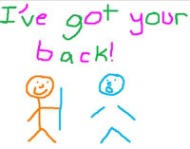
Relationships – “ I've Got Your Back”

[caption id="" align="alignright" width="190"]Got your back Relationships - Covering One's Back[/caption]

I read two interesting books recently by former Navy SEAL Marcus Luttrell. The titles were “The Lone Survivor” and “Service.” Luttrell writes eloquently about the most powerful attribute of a SEAL, that of being a part of a team. During training, SEALS have a designated partner. They will never be more than an arm’s length from their partner. Throughout their SEAL career, they are confident that someone has their back – someone who will die for them if necessary.

I was reminded of “Band of Brothers” by Stephan Ambrose. Some members of Easy Company, 506th Regiment, 101st Airborne after D-Day went AWOL back to the Company from hospitals in England before their injuries were healed. Why? Army policy said that injured soldiers were to be attached to replacement companies upon their detachment from the hospital. The brothers would rather go back into war with unhealed injuries than go back into war in a brand-new company because they couldn’t trust the new recruits to “have their backs” like Easy Company would.

Four Important Words - "I've Got Your Back"

They are perhaps the most important words you can say in any relationship. They give your partner great freedom and protection.

What those four words could mean to your spouse

Those words imply great love, great trust, and great commitment. Your spouse will be free to grow and explore their life both inside and outside the relationship. You’re saying that you will be their best interests above your self-interests. You’re saying that nothing in their past can rise up and hurt them because you've got their back. You’re saying that you will continue to love them if they make mistakes. You’re saying that you’ll forgive and move forward with them.

What those four words could mean to your children

You give them the freedom to react to the roadblocks of life knowing that mom or dad will stand up with them. I made serious mistakes years ago because I tried to prepare the way for my sons rather that giving them the privilege of learning how to solve their own problems.

True story (names are changed): Brian (5th grade) came home several days from school in a bad mood. Finally his dad got it out of him that Robert (long time friend) was really hassling him at school. Dad suggested telling the teacher or going to the principle. Brian rejected both because of the teachers knew about it and weren't doing anything about it. Finally, dad told Brian to clearly tell Robert to stop; and if he didn't  Brian had permission make him stop.

Brian objected again because he would be suspended from school for fighting. Dad told Brian that if it took fighting to make Robert stop, he would back Brian in whatever happened. End of discussion.

Several days later, dad noticed that Brian was his old happy self. He asked him about Robert. Brian simply smiled and said, “I took care of it.” Dad still doesn't know, 25 years later, what happened to resolve the problem.

The point – Dad, in effect, told Brian, “ I've got your back.” In doing so, he gave Brian the freedom to solve a problem himself.

We can’t protect our kids from the world without running the risk that they won’t learn how to live in it. We just have to “have their backs.”

What if you can’t say those four words

All kinds of negative things can make it impossible to commit to “having someone’s back.” Think about the strength and fulfillment you can bring to any relationship if you take those negative emotions under control. You have peace and strong relationships to gain and nothing to lose.

We can show you ways to do that. Think about it!

Rod Peeks

www.findingpersonalpeace.com

Thanks for reading our blog today. I invite you to respond in several ways: (1) Comment in the space below if you agree or disagree with what I've said. A dialogue could be interesting for all; (2) Share the post with your friends. There are buttons below for Facebook, Twitter, and other social media sites; and (3) sign up for an email with each new post. There’s a place to do that on the right. Then you won’t have to remember to look for subsequent posts. Thanks again!
Wednesday, January 16, 2013

Are you the Wedge in Your Relationships?

[caption id="" align="alignright" width="58"]wedge Don't Be the Wedge[/caption]

Make a list of your important relationships. Don’t rank them; just list them.

On a scale of 1 to 10 (insignificant to incredibly important) rank each of those relationships. How important are they to you? Write the number down for each.

Now, on the same scale, rank how you think the other person might view each relationship from their perspective. Be honest. This is just between you and me.

If your ranking is the same as your partner’s; that’s pretty good unless both your numbers are so low you have to wonder why either of you should remain in the relationship.

If your ranking is less that your partner’s or if your ranking is higher than your partner’s, you may have a problem. Either your partner is getting the short straw or you are.

What to do?

If your ranking is significantly higher than your partner, you may be paying sufficient attention to the relationship; but not necessarily the right kind of attention. The time and energy you’re investing may be directed in a way that doesn't meet the needs of your partner.

  • You’re working hard to provide nice possessions and your partner wants more of your time.

  • You’re full of grand ideas for fun and fulfillment; but your partner is always worrying about getting the bills paid.

  • You talk with your partner all the time; but the conversation is mostly superficial, not really getting to substantive issues. So you don’t really know your partner’s heart.

  • You spend lots of time doing things around the house; but they’re the things you want to do rather than the things your partner wants done.


If your ranking is significantly lower than your partner, you may not be responding to your partner’s attempts to please you.

  • You work more than you really need to work to avoid more intimate contact with your partner.

  • You don’t appear to be grateful for the things your partner does for you.

  • Your partner’s ideas for fun and fulfillment are met by your excuses for not doing them; or maybe just a lack of any response.

  • You don’t participate in the decision-making process in the partnership leaving the responsibility to your partner.


This layman’s analysis may not fit anything in your relationships; but somebody needs to pay a little attention to the balance in your relationship. There’s nobody better to do that than you. Make your relationships a priority for you.

You’re can only change yourself – you can’t change your partner

Over the next few days, take note of your thinking. If you discover thoughts that appear to be a wedge in your relationships, you can stop thinking about those things.

If you discover that you’re routinely putting down your partner and/or their suggestions, you can change your reactions.

If you habitually make excuses, pass off decisions, shortchange on time, or fail to appreciate or respect your partner, you can break those habits.

How? Take a good look at Finding Personal Peace. It can show you how to change your thinking.

Make a priority of working toward balance in your relationships. Work toward improving the relationship for both of you. The rewards are priceless.

God bless,

Rod Peeks

www.findingpersonalpeace.com

Thanks for reading our blog today. I invite you to respond in several ways: (1) Comment in the space below if you agree or disagree with what I’ve said. A dialogue could be interesting for all; (2) Share the post with your friends. There are buttons below for Facebook, Twitter, and other social media sites; and (3) sign up for an email with each new post. There’s a place to do that on the right. Then you won’t have to remember to look for subsequent posts. Thanks again!

Tuesday, January 15, 2013

Invest in Your Relationships

[caption id="" align="alignright" width="160"]Invest in your Relationships Getting a Return on Your Relationships?[/caption]

Very few things in life just happen. It almost always takes an investment – of our time; of our energy; of our emotions; of our money.

Invest time in your relationships

This is especially true of relationships with your children. They don’t care that you’re working two jobs to provide for them. Your child needs a little bit of you each day – one-on-one. Your spouse needs to have some of your time just to know that the relationship is important to you. Shared time doesn't count nearly as much as individual time. Sitting in the same room watching TV is a start. Reading a book to your child is better. Working together on chores is a great way to spend time with spouse or children. Be creative. There’s nothing more important than investing time in each relationship that’s important to you.

Invest energy in your relationships

Go out of your way to surprise your spouse or children occasionally. Put a loving note in the suitcase or briefcase. Put an encouraging, happy note in the lunchboxes. Offer a shoulder or neck massage to your spouse. Who knows what that might lead to. Offer a shoulder to cry on or an ear to hear their frustration. It may take a lot of energy just to listen without offering advice.

Don’t just coast and expect the relationship to prosper. Invest energy. You may have to spend energy thinking of ways to invest more time.

Invest emotions in your relationships

Let yourself be vulnerable. Don’t mask your loving emotions in your relationships. Express love with no expectations of return. Express unconditional love.

If you’re apart, make sure they know you’re thinking about them. Hide your disappointment except in a teachable moment with children. Be willing to reach out without expecting a reach back.

Invest money in your relationships

This is last because it may be the least important. It certainly shouldn't be used to replace any of the other investments. Spend all you can reasonably spend on anniversaries and birthdays with emphasis on the word reasonable. If money is tight, wrap the package in time, energy, and emotion. A handmade card or note from your heart will mean more than Hallmark.

I know a couple of families with limited resources and large families. They celebrate Christmas more in worship and time together than in giving gifts to everyone. But birthdays are special. That’s one person’s special day and they make that a big deal.

Don’t expect a return on your investment

If you expect a return you might be disappointed sometimes. Expect nothing, but rejoice in everything. But I’m pretty comfortable predicting that if you invest diligently, you will have a wonderful return.

If you find yourself reacting negatively to these investments, examine your thinking. Be sure to apply the principles of my last posting (Click here) before you react outwardly.

You may be right. Perhaps your partner didn't react well to your investment. But be careful how you react. Would you rather be right or alone?

If your negative thinking is hurting your relationship, then take control of your thinking. That’s what Finding Personal Peace teaches you to do.

Invest, invest, invest. The return may be life-changing.

All the best,

Rod Peeks

www.findingpersonalpeace.com

Thanks for reading our blog today. I invite you to respond in several ways: (1) Comment in the space below if you agree or disagree with what I’ve said. A dialogue could be interesting for all; (2) Share the post with your friends. There are buttons below for Facebook, Twitter, and other social media sites; and (3) sign up for an email with each new post. There’s a place to do that on the right. Then you won’t have to remember to look for subsequent posts. Thanks again!